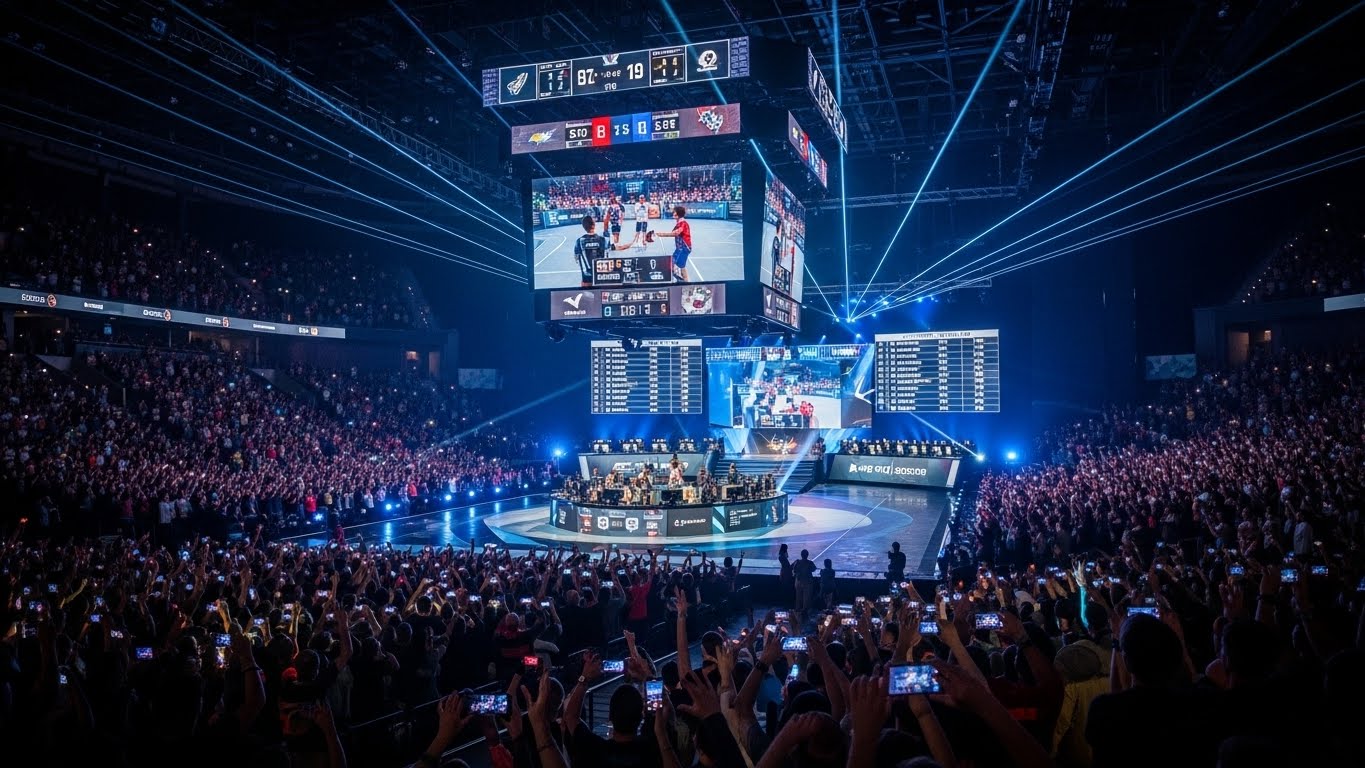
In the summer of 2013, over 32 million people tuned in online to watch the League of Legends World Championship finals. That figure — roughly equivalent to the viewership of the Academy Awards that same year — sent a clear signal to anyone still wondering whether competitive gaming was a niche hobby or something more: esports had arrived, and it wasn't going anywhere.
The road to that moment was longer and stranger than most people realise. Competitive gaming didn't emerge from a boardroom strategy or a calculated industry pivot. It grew organically, fuelled by passionate players who simply wanted to find out who was the best — and by communities who gathered around them to watch.
Where It All Started: Tournaments Before the Internet
The competitive gaming instinct predates the internet by decades. Atari organised the first documented gaming tournament in 1980 — the Space Invaders Championship, which drew around 10,000 participants across the United States. For its time, it was a remarkable logistical undertaking, and it proved something important: players were deeply motivated by competition, not just by individual achievement.
Through the 1980s and early 1990s, competitive gaming existed in a patchwork of small local tournaments, arcade high-score competitions, and console battles among friends. The culture was real, but it lacked infrastructure. There was no way to compete nationally, no broadcast platform, no professional circuit.
The first seeds of what we'd recognise as esports were planted in South Korea. Following the Asian financial crisis of 1997, the Korean government invested heavily in broadband internet infrastructure, making high-speed internet access affordable and widespread far earlier than in most countries. Starcraft: Brood War, released in 1998, became a national obsession. PC gaming cafes — known as PC bangs — spread across the country. By the early 2000s, Starcraft matches were being broadcast on dedicated cable television channels, and top players were earning salaries, attracting sponsors, and being treated as genuine celebrities.
South Korea didn't just adopt esports — it invented the template that the rest of the world would eventually follow. Professional contracts, broadcast rights, stadium events, and celebrity players all emerged from the Korean scene first.
The LAN Party Era and Western Roots
While South Korea was building a broadcast esports industry, Western competitive gaming developed through a different culture: the LAN party. Before home broadband was common, players who wanted to compete online had to physically gather, bring their computers, and connect to a local network. These events — held in community centres, church halls, university campuses, and hotel conference rooms — became the social heartbeat of competitive PC gaming in Europe and North America.
Games like Quake, Counter-Strike, and StarCraft drew fierce competition at events like QuakeCon and the Cyberathlete Professional League. The prize pools were modest by today's standards, but the passion was genuine and the skill levels were extraordinary. Players practised for hours every day, developing techniques and strategies that would define their games for years.
The Cyberathlete Professional League, founded in 1997, is widely considered the first professional esports organisation in the Western world. It organised structured competitive seasons, paid prize money, and attracted sponsorship from hardware companies eager to reach the dedicated gaming demographic. It was imperfect and underfunded by modern standards, but it was a genuine professional circuit — and it proved that one could exist.
Streaming Changes Everything (2011–2016)
If one single technological development deserves credit for accelerating esports from a niche scene into a global industry, it's the emergence of live streaming — specifically Twitch, which launched in 2011. Before Twitch, watching competitive gaming meant either attending an event in person or finding a recorded broadcast. Live streaming removed all the friction from watching, and in doing so, it transformed the relationship between players and audiences.
Suddenly, anyone could broadcast themselves gaming. Top players could stream their practice sessions and attract thousands of viewers. Tournaments could reach global audiences without requiring broadcast deals. And crucially, audiences could interact in real time through chat, creating a viewing experience unlike anything traditional sports television could offer.
League of Legends, Dota 2, and Counter-Strike: Global Offensive emerged as the dominant esports titles of this era. Riot Games, the developer behind League of Legends, made a deliberate decision to build esports infrastructure as part of the game's design — creating structured regional leagues, funding teams, and investing heavily in production quality for broadcasts. It was the first time a major game developer had committed to esports as a core business strategy rather than an afterthought.
Dota 2's The International tournament, first held in 2011, took a different approach: a crowdfunded prize pool that grew with community participation. The prize pool for The International 2021 exceeded $40 million — funded almost entirely by player contributions through in-game purchases. It remains one of the largest prize pools in the history of competitive gaming.
Mainstream Recognition and Structural Growth (2017–Present)
By the late 2010s, esports had entered a new phase of development: institutional recognition. Universities began offering esports scholarships. The International Olympic Committee held discussions about whether esports might one day feature at the Olympics. Traditional sports franchise owners — from the NBA's Cleveland Cavaliers to English Premier League football clubs — began acquiring esports teams as genuine investment assets.
The Overwatch League, launched in 2018 by Activision Blizzard, attempted to replicate the franchise-based model of traditional sports leagues, with city-based teams, permanent rosters, and salaries with benefits. While the league faced challenges in its early years, it represented a significant moment: a major publisher committing hundreds of millions of dollars to building a structured professional circuit around a single game.
Mobile esports brought competitive gaming to audiences in Asia, Southeast Asia, Latin America, and Africa who might not have access to high-end gaming PCs or consoles. Games like PUBG Mobile, Mobile Legends, and Free Fire developed their own competitive ecosystems with tournaments and prize pools that rival their PC counterparts.
The People at the Centre
It's easy to get lost in the structural and financial story of esports and forget what drives it at the human level: players who dedicate themselves completely to mastering their craft. The training regimes of top esports athletes are genuinely gruelling — 10 to 14 hours of practice daily is common among professionals in Korean and Chinese leagues, often supplemented by physical conditioning and psychological coaching.
The careers of players like Faker in League of Legends — who has competed professionally since 2013 and is widely considered the greatest player in his game's history — demonstrate that mastery in esports is real, hard-won, and genuinely impressive to watch. Faker's career has been marked by extraordinary consistency, technical brilliance, and an obvious joy in competition that translates through a screen to millions of viewers worldwide.
The community around esports — the analysts, commentators, content creators, coaches, and fans — has also matured significantly. Esports commentary has developed its own vocabulary, its own analytical frameworks, and its own personalities who are beloved by the community. The production quality of major esports broadcasts now matches or exceeds traditional sports television in terms of visual storytelling and real-time data presentation.
What Comes Next
Esports is still an industry in active development. Challenges remain: player burnout, the short professional lifespan of many athletes, questions about governance and player welfare, and the uncertainty of building sustainable businesses around games that can fall out of popularity. Not every attempt at an esports league has succeeded, and the landscape has changed significantly as some titles have declined while others have risen.
But the fundamentals are solid. Competitive gaming is now woven into the cultural fabric of gaming globally. Hundreds of millions of people watch esports at some level, whether that's a local tournament stream or a World Championship broadcast with production budgets that dwarf traditional sports coverage. Young players grow up with esports as an obvious career aspiration in a way that simply wasn't possible twenty years ago.
The story of esports is still being written. The players competing in arenas today are creating the history that future generations will look back on. And if the past three decades are any guide, the most remarkable chapters are probably still ahead.
Yuki Tanaka
Culture Writer at Your Gaming Arena. Specialises in esports history, JRPG lore, and the intersection of gaming and identity.